01 The hook
"I'm skeptical about meal replacements - are they any good for me?"
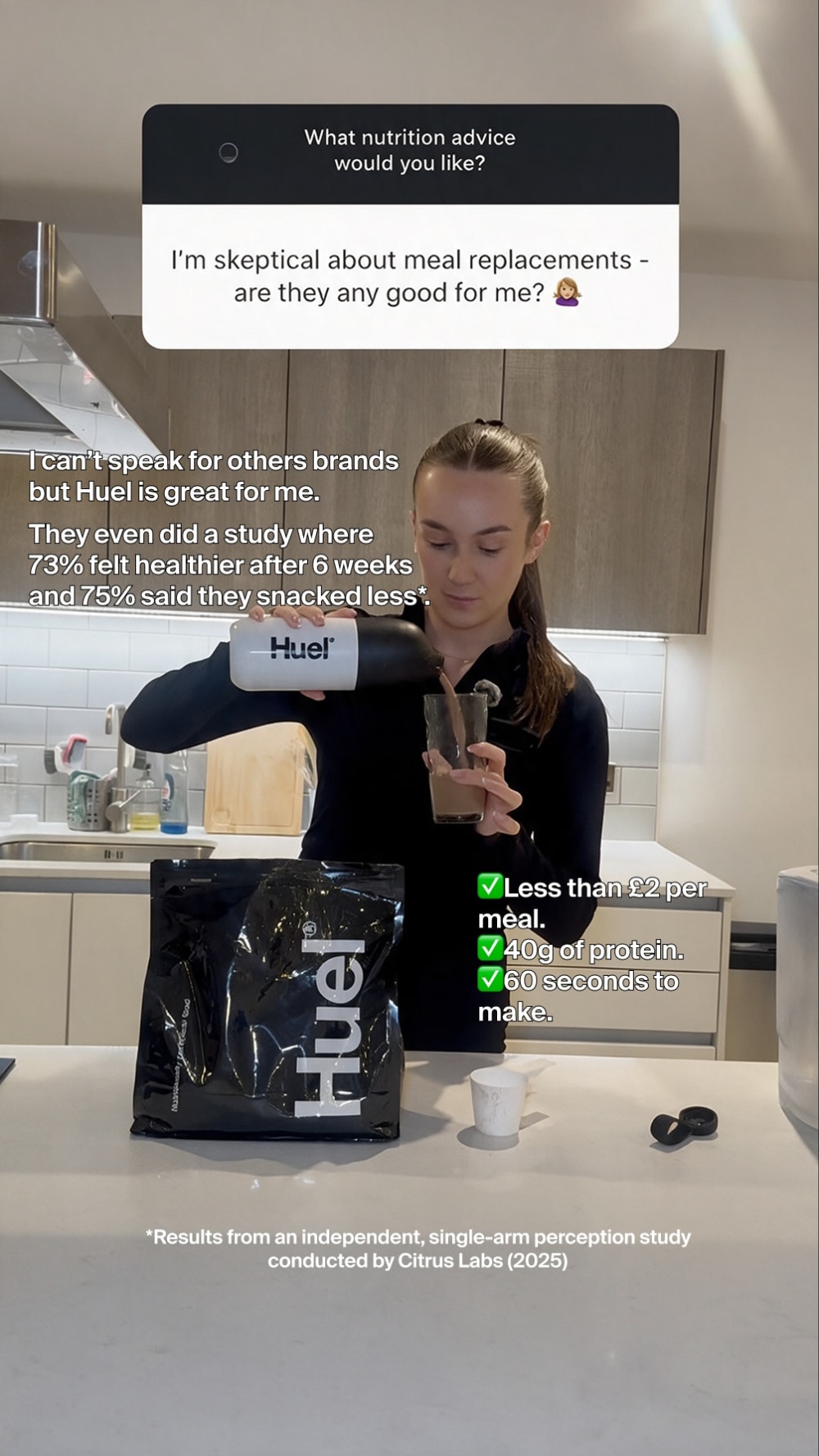
The picture copies an Instagram story. At the top sits a white question box with a small avatar and the prompt "What nutrition advice would you like?". Inside it is the viewer's question: "I'm skeptical about meal replacements - are they any good for me?" with a shrugging emoji. Under it, a woman in a kitchen pours a shake from a black Huel bottle into a glass, with a black Huel pouch on the counter. The answer is plain white text on the photo, left-aligned: "I can't speak for others brands but Huel is great for me." The caption opens "Busy day?" and the library card's headline is "This Is A Meal. Not A Protein Shake."
02 The offer
There is no discount in the picture. The answer carries a study line: "They even did a study where 73% felt healthier after 6 weeks and 75% said they snacked less*." The fine print says "*Results from an independent, single-arm perception study conducted by Citrus Labs (2025)". Three ticked lines sit lower right: "Less than £2 per meal.", "40g of protein." and "60 seconds to make." The caption says Huel is packed with plant-based protein and nutrients, "Ready in secs, frees up your lunch", "No kitchen required" and "26 essential vitamins and minerals", with a footnote about vitamin B12 and iron and tiredness. The card's button is Shop Now. The numbers are the ad's own claims, shown here as the ad states them.
03 The structure
- 01A white question box in the Instagram story style: "What nutrition advice would you like?"
- 02The viewer's question: "I'm skeptical about meal replacements - are they any good for me?"
- 03A creator in a kitchen pours a Huel shake, with a black Huel pouch on the counter.
- 04The answer in plain white text: "I can't speak for others brands but Huel is great for me." Then the study line: 73% felt healthier after 6 weeks, 75% said they snacked less.
- 05Three ticked lines: less than £2 per meal, 40g of protein, 60 seconds to make.
- 06Fine print at the bottom: the Citrus Labs perception study.
04 Why it works
This is a reading of the creative, not proof of results: the Ad Library shows when ads ran, not how they performed, and it says nothing about whether the study claim is true. The doubt comes first, in a viewer's voice, so the ad answers an objection instead of making a claim cold. Because it looks like an answered question sticker on a story, it borrows the casual feel, and some of the trust, of a creator replying to a follower. The answer is short, the study line has its source in the fine print, and the close is three ticked specifics. The same sticker look runs in four ads on the Page: this one (9 Oct 2026), two ads that ask about the Selection box with different photos (19 Oct) and a 31 Oct ad where the question is "Why did you start drinking Huel for breakfast?" with a "2016 me" and "2026 me" list. The library flags the first three "Low impression count" (under 100 impressions), so only the 31 Oct ad is counted and the numbers are a floor that will change when the flagged ads clear the flag. The pictured ad is one of the flagged ones. A different look on the Page, bold "three reasons" text over a photo of a Huel bottle, is not counted. Only active ads were pulled, so earlier runs, if there were any, are not in the numbers.